Your competitors’ reviews: what they teach you about yourself
Your neighbours’ Google reviews are public. Read with method, they tell you why a customer would go next door, what the whole area is criticised for, and what nobody offers yet. The method, in five questions.
Also available in: French
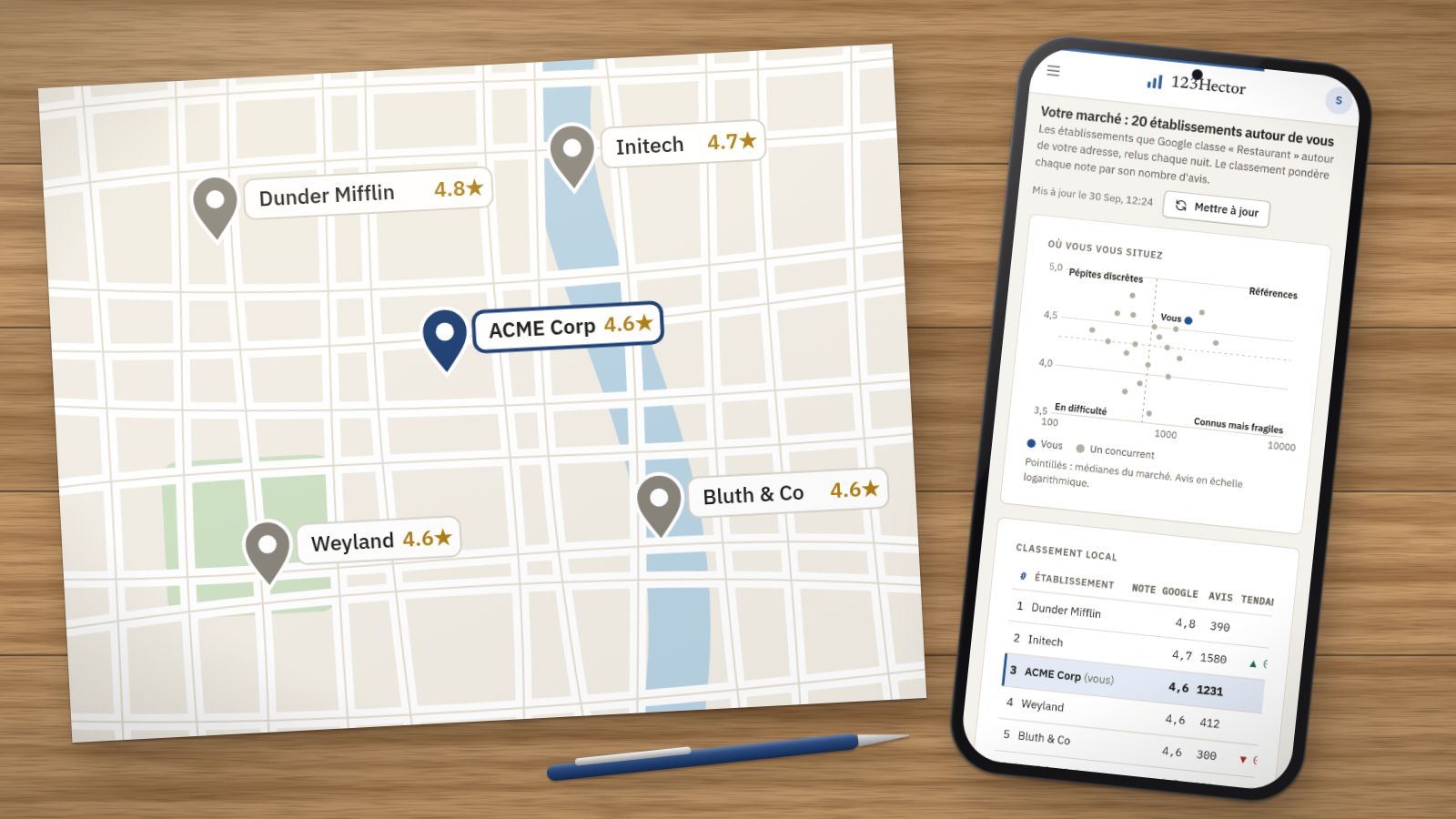
Before coming, a customer compares: the rating, the number of reviews, the latest comments, at your place and next door. Your competitors’ reviews are public, and read with method they tell you what your own reviews cannot: why a customer would go next door.
Here is the method, in five questions.
1. Who are your competitors, really?
Not necessarily the ones you think of. They are the ones Google shows next to you for the same search: the same Google category, around your address. Start from that list, remove those that do not offer the same thing, and add the one that is missing.
2. Compare ratings without fooling yourself
A 4.9 on twelve reviews is not worth a 4.7 on a thousand: the first can lose two tenths in a week. Compare ratings taking the number of reviews into account, then look at two more figures:
- the pace, the number of new reviews a month: whoever collects the most has a recent rating, and customers see their reviews first;
- the replies, the share of recent reviews that have one: a neighbour who does not reply leaves you an easy place to take.
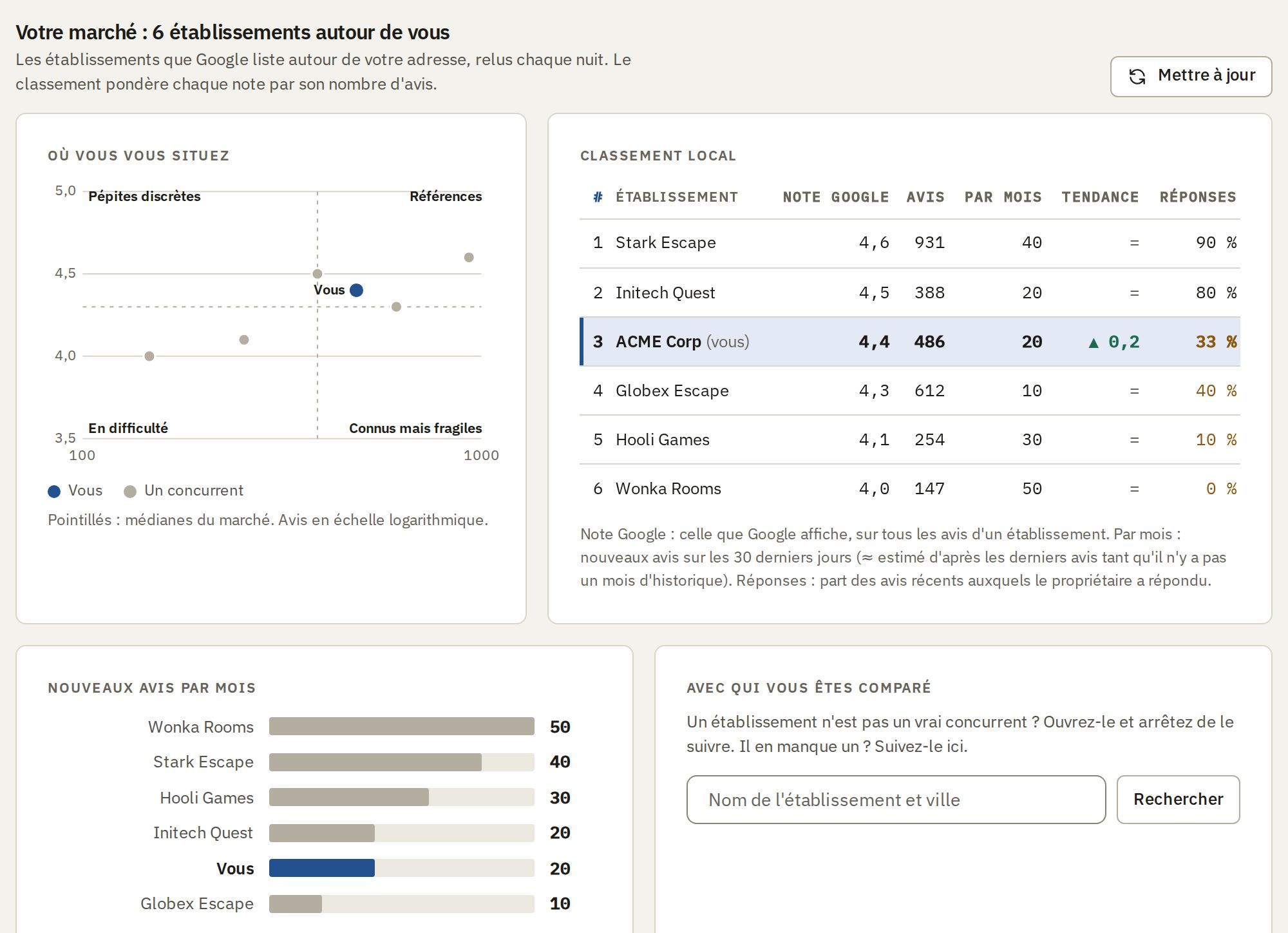 ACME Corp’s market: the references, the hidden gems, the fragile ones, and the weighted ranking. (Our screenshots are of the French app.)
3. What do their customers complain about, and yours?
Read their recent reviews as you read yours: sorted by subject (the wait, the welcome, cleanliness, price…), noting for each the share of negative mentions. Then compare, subject by subject.
- Where you lose. Your customers complain about a subject clearly more than theirs: that is where a customer who compares goes next door. Fix it first.
- Your edge. Their customers criticise them for a subject yours do not complain about: it is an argument. Say it on your Google listing, your website and in your replies.
- The whole area’s problem. Everyone is criticised for the same subject, parking for example: it is not you, it is the place. Whoever solves it first stands out.
One precaution: only compare subjects mentioned often enough on both sides. A share computed on three reviews says almost nothing.
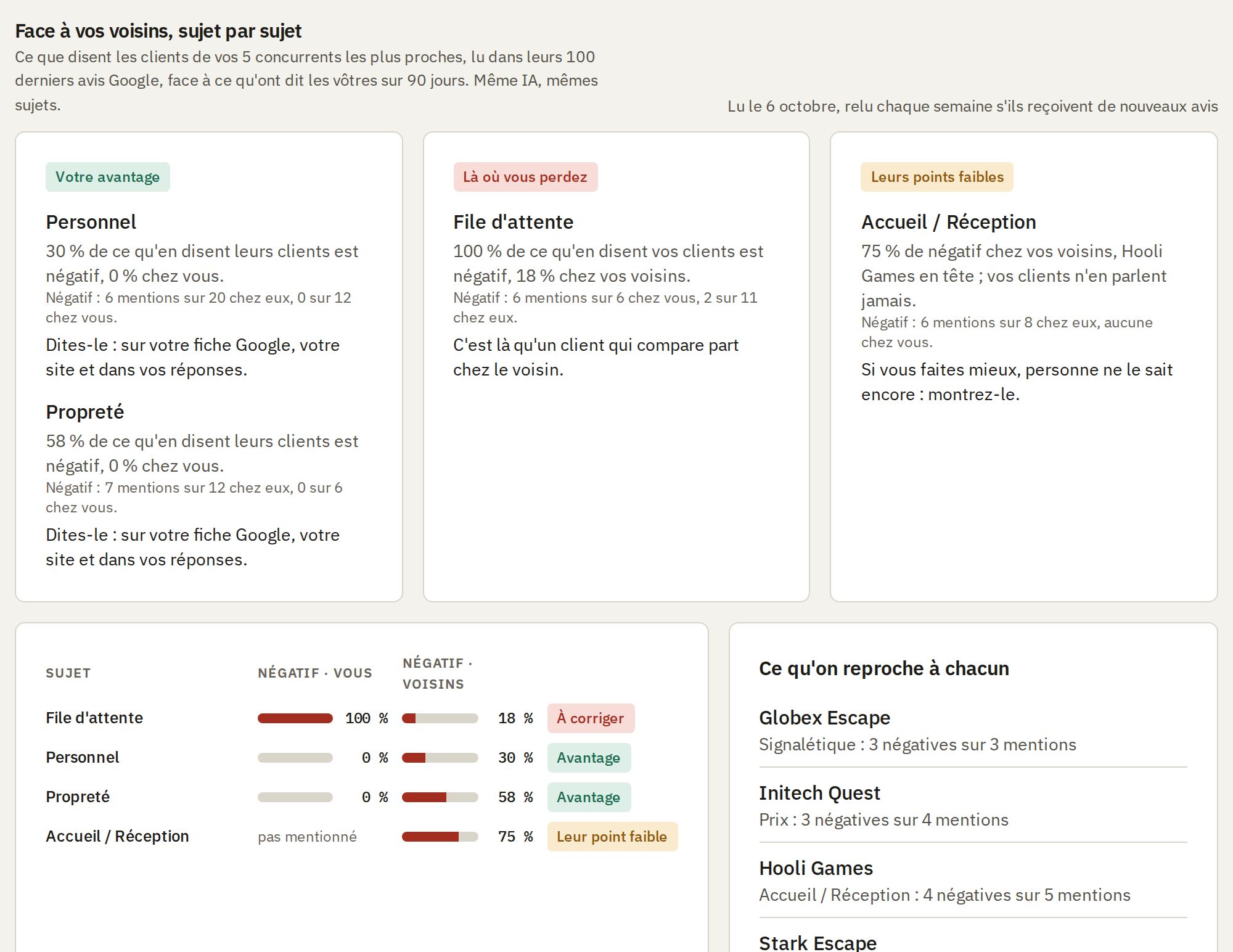 Where ACME Corp loses, where it wins, and what each neighbour is criticised for.
4. What does nobody offer yet?
Customers also write what they missed: “a pity there is no game in English”, “nowhere to wait”. One wish says nothing; the same wish at several venues in the area says there is a need.
- If nobody offers it, the place is free: you would be the only one.
- If a neighbour is praised for it, do it too, and say so.
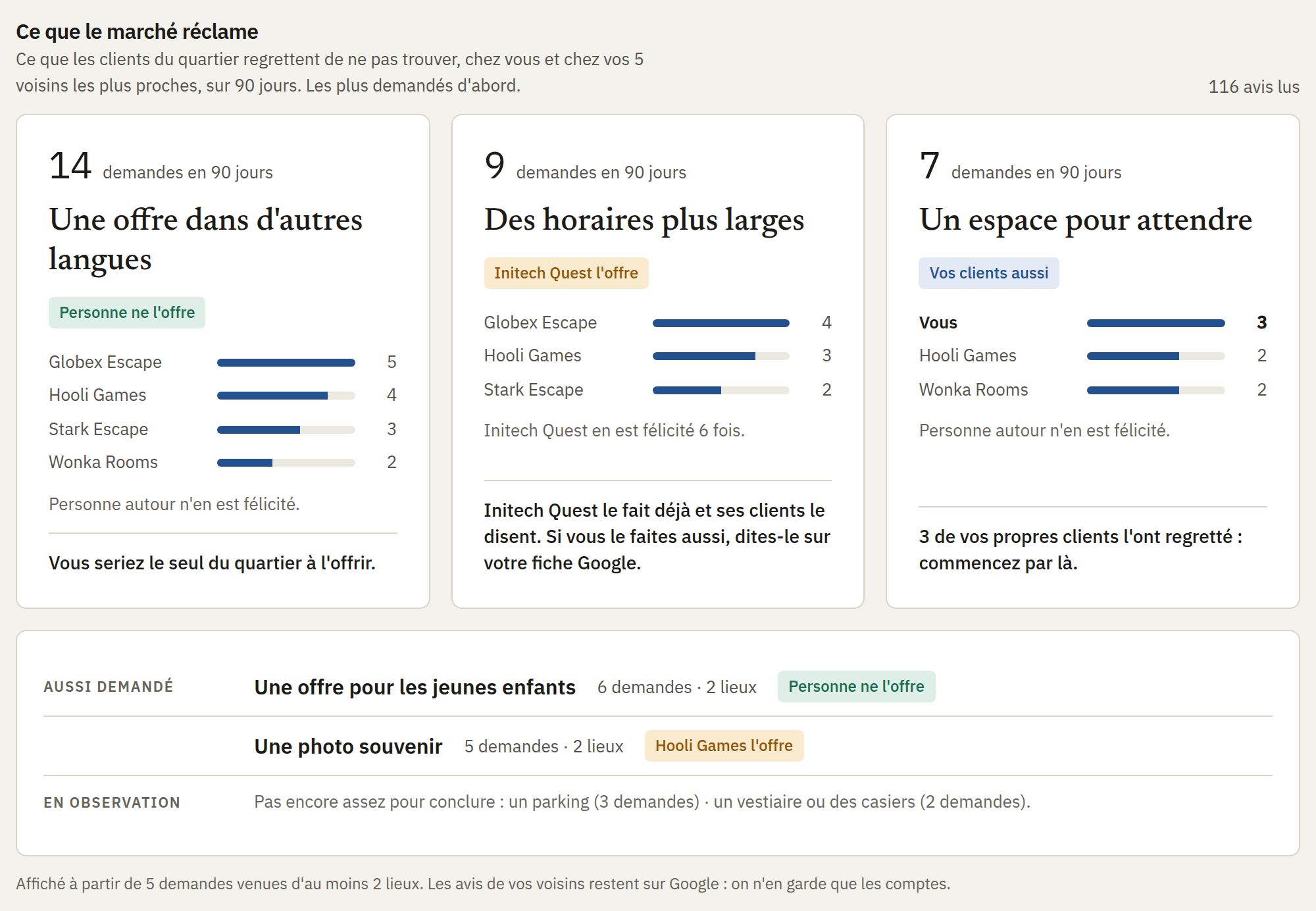 Each card is a need: how many customers expressed it, where, and who already meets it.
5. How do they reply?
Look at their replies: how many, how quickly, in what tone. If they do not reply, replying to every one of your reviews sets you apart at little cost. If they reply well, that is the bar to reach.
What not to do
- Leave reviews on their listing. A review of a competitor is a conflict of interest, banned by Google, and a fake review can be costly (we explain it in our article on fake reviews).
- Copy their reviews. You read, you count, you draw conclusions: you do not republish what their customers wrote.
- Change everything because of one review. A trend is read over dozens of reviews, not the latest one.
By hand, or with 123Hector
By hand, the method fits in a spreadsheet: five neighbours, their last thirty reviews each, one column per subject, an update every quarter. Count a few hours each time.
123Hector does it every night. It reads the venues of your Google category around your address and ranks them on their rating weighted by their number of reviews, with their pace and their replies. The latest reviews of your closest competitors are read by the same AI as yours, sorted into the same subjects, and read again every week new ones arrive. Only the counts per subject are kept, never their reviews.
The free audit already makes a first comparison with your neighbours: it reaches you by email within minutes.
Sources
- Google, how to improve your local ranking on Google: relevance, distance and prominence.
- Google, prohibited and restricted content on Maps: conflict of interest.
Want to see what your reviews say?
Get a free AI-powered audit of your venue's online reviews. No credit card required.
Get your free auditKeep reading
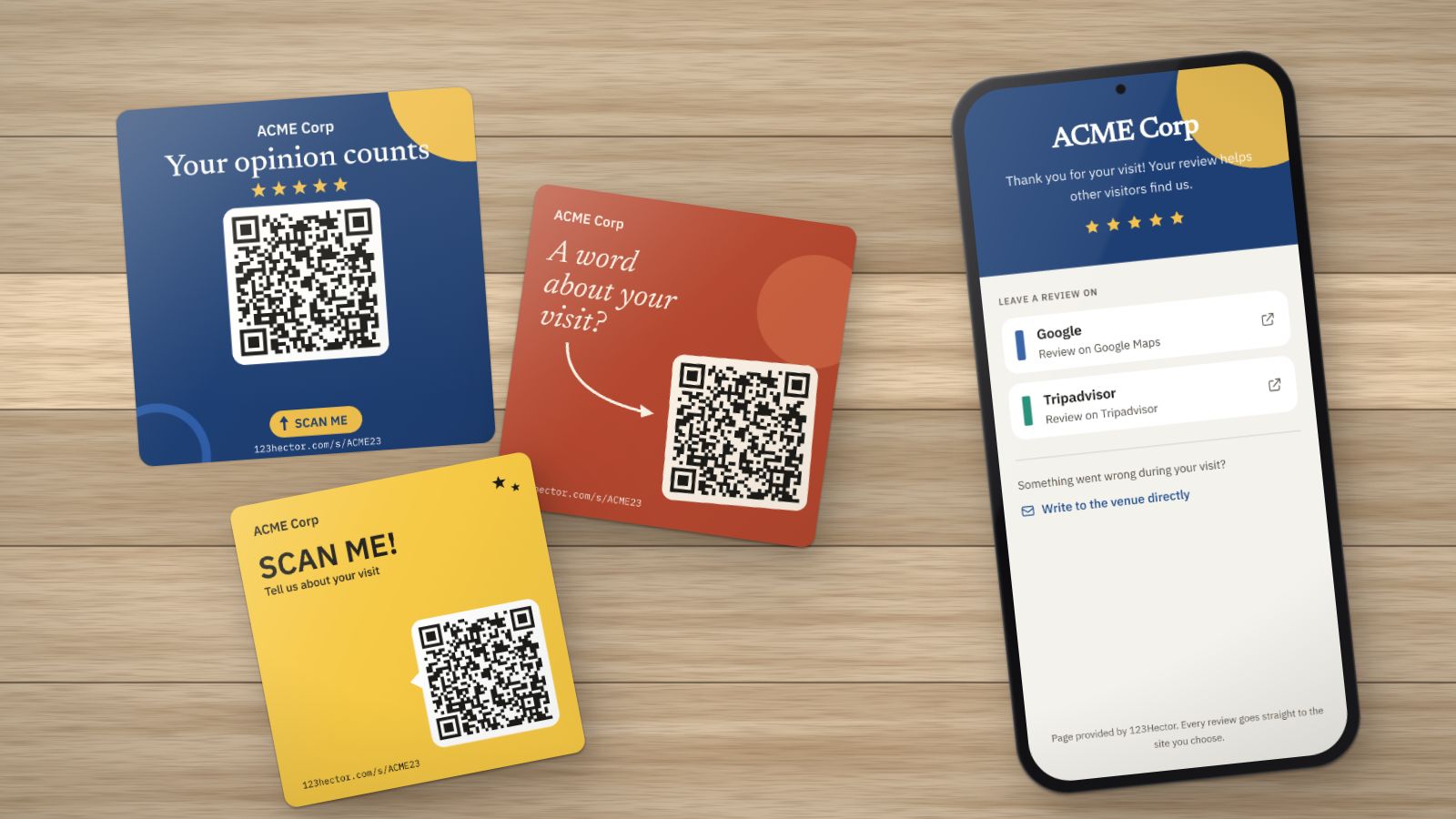
How to get more Google reviews: 8 methods that work (and 3 that are banned)
Ask at the right moment, in the right place, with the right link: the methods that bring Google reviews to a visitor attraction or leisure venue, without buying them or sorting customers. And what Google and the law forbid.
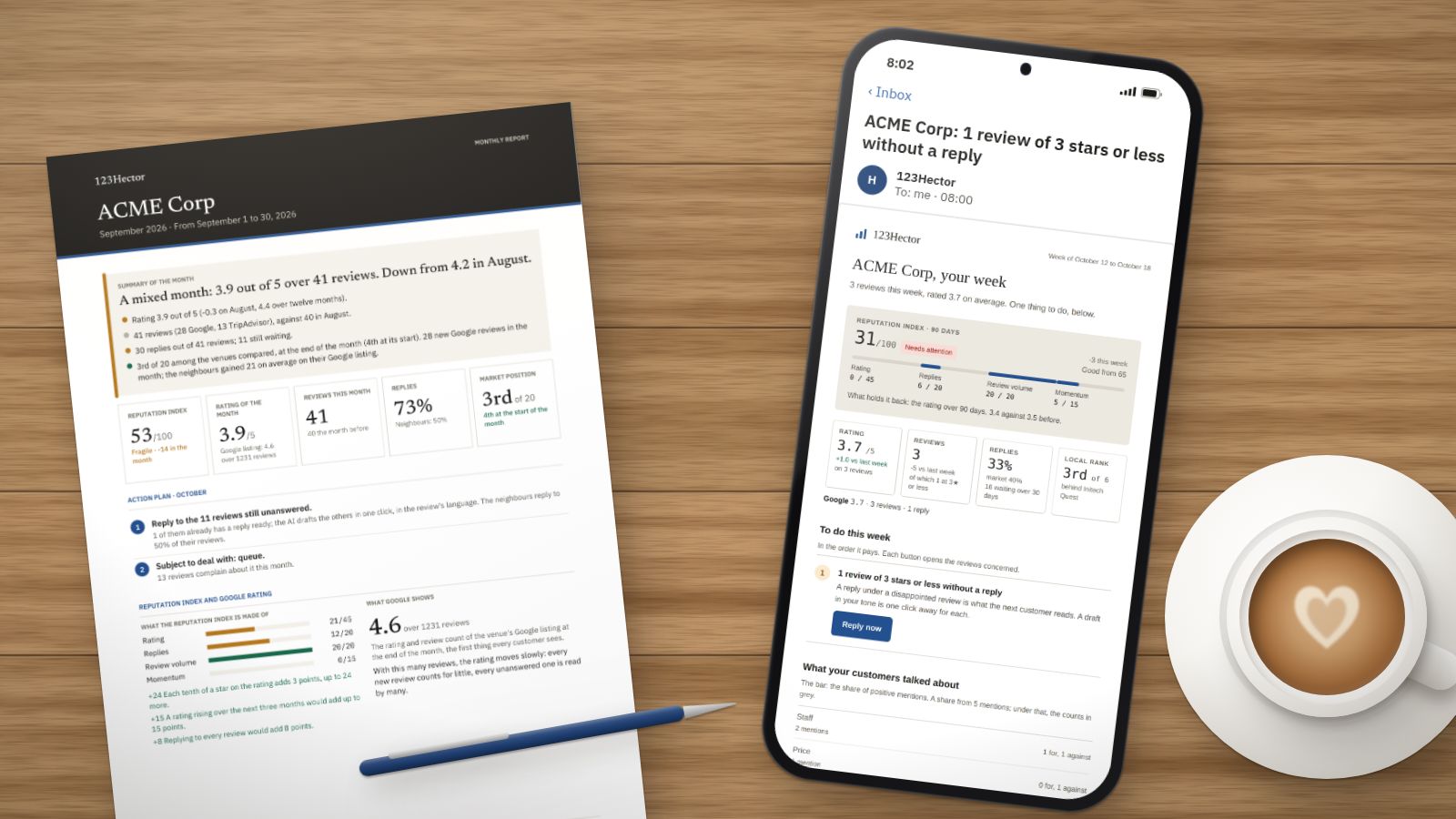
A week with 123Hector: what it does with your reviews, Monday to Sunday
The Monday email, the alert on the day a bad review lands, the reply already written, the competitors, the month’s report: a week in the life of a fictitious venue, ACME Corp, screen by screen.
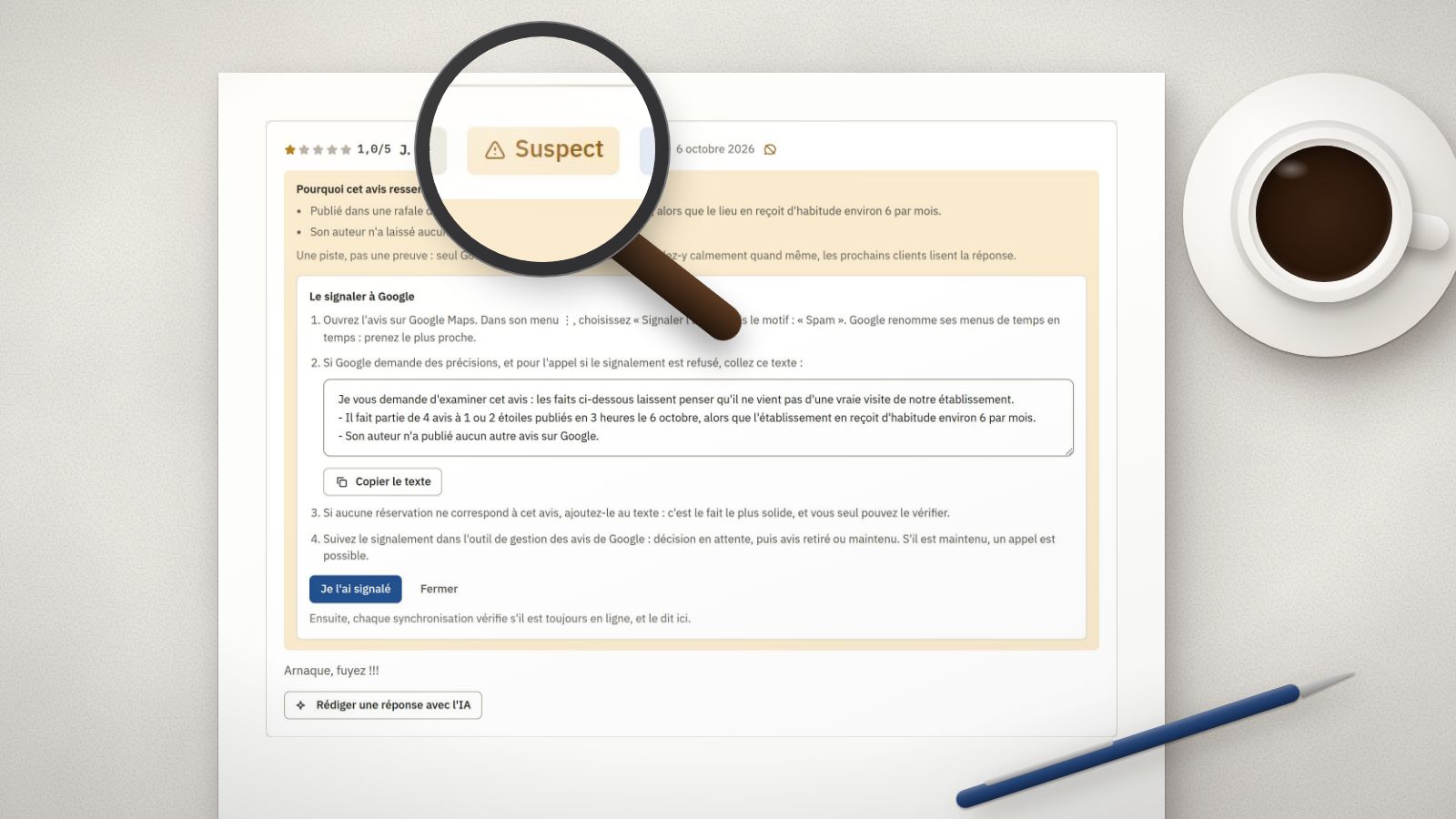
Fake Google reviews: how to spot them, report them and reply
A burst of 1-star ratings in one night, an account with no other review, a text about another place: the signs of a fake review, the steps to report it to Google, and the reply to publish meanwhile.